My research is focused on
Large Language Models (LLMs),
Multimodal Large Language Models (MLLMs),
Mathematical Reasoning, and general
Artificial Intelligence (AI) to solve complex
problems and advance the field. In my teaching, I want to help
students gain the knowledge and skills to use computational
techniques for solving real-world problems with creativity and
integrity.
PhD Applicant | Fall 2026
Research Interests
Large Language Models
LLM architectures, training, and optimization
Multimodal LLMs
Vision-language integration and understanding
Mathematical Reasoning
Problem solving and logical inference in AI
Artificial Intelligence
General AI for complex problem solving
Education
Master of Science in Computer Science & Engineering
United International University, Dhaka,
Bangladesh
Focus: Artificial Intelligence & Machine Learning
CGPA: 3.83/4.00
Graduated: 2025
Bachelor of Science in Computer Science & Engineering
United International University, Dhaka,
Bangladesh
CGPA: 3.49/4.00
Graduated: 2021
Higher Secondary Certificate (HSC)
Dhaka Residential Model College
GPA: 5.00/5.00
Secondary School Certificate (SSC)
Monipur High School
GPA: 5.00/5.00
Professional Experience
Lecturer &
Programming Contest Coordinator
University of Scholars
2024 – Present
Leading academic courses in Data Structures, Algorithms, and
competitive programming. Coordinating programming contests and
mentoring students in problem-solving techniques.
Research
Assistant
BRAC University
2025 – Present
Conduct literature reviews on LLMs & VLMs, specializing in
mathematical and geometrical reasoning
Evaluate and benchmark model performance on geometry-based
reasoning tasks
Refine research ideas and methodologies under the guidance of
Prof. Dr. Swakkhar Shatabda
Provide technical mentorship to thesis groups, including code
development, debugging, and review
Translate academic research into practical insights to advance
ongoing AI projects
Other Positions:
Research Assistant, State University of Bangladesh
Junior Software Engineer, Orange Solutions LTD
Trainee, Bangladesh-Japan ICT Engineers' Training Program
TextEconomizer: Enhancing Lossy Text Compression with Denoising
Transformers and Entropy Coding
Information and Communication Technology Division, Government of
Bangladesh | 2024-2025
Amount: BDT 150,000 | M.Sc. Thesis Research
focusing on advanced text compression techniques using denoising
transformers and entropy coding methods.
Co-Principal Investigator
BanglaHateCorpus: A Large-Scale Bangla Benchmark for Hate Speech
Classification and a Transformer-Based Deep Learning Method
Information and Communication Technology Division, Government of
Bangladesh | 2023-2024
Amount: BDT 330,000 | Development of a
comprehensive Bangla hate speech detection corpus with
transformer-based deep learning methodology.
Awards & Achievements
Summa Cum Laude / Dean's List
United International University - MSc Program (CGPA: 3.83)
Merit-Based Scholarship
United International University - For Academic Excellence
Perfect Academic Records
HSC and SSC with GPA 5.00 - Top 1% performers
Government Board Stipend
2007 - Government Board Stipend in Primary School
Research Publications
6+ publications in peer-reviewed conferences and journals
ICPC Contests
2025 ICPC Asia Dhaka Regional: Ranks 146, 226,
231 (Coach and Instructor)
2025 ICPC Asia Dhaka Regional Preliminary: Ranks
39, 42, 80, 881 (Coach and Instructor)
2024 ICPC Asia Dhaka Regional: Rank 201 (Coach
and Instructor)
2019 ICPC Dhaka Regional Preliminary Contest
2018 UIU Coders Combat Programming Contest
2017 ICPC Dhaka Regional Preliminary Contest
Publications & Research Work
ACL2025
MathMist: A Parallel Multilingual Benchmark Dataset for Mathematical
Problem Solving and Reasoning
ARR October Cycle 2025 | Conference Paper
Mathematical reasoning remains one of the most challenging domains for
large language models (LLMs), requiring not only linguistic
understanding but also structured logical deduction and numerical
precision. While recent LLMs demonstrate strong general-purpose
reasoning abilities, their mathematical competence across diverse
languages remains underexplored. Existing benchmarks primarily focus on
English or a narrow subset of high-resource languages, leaving
significant gaps in assessing multilingual and cross-lingual
mathematical reasoning. To address this, we introduce MathMist, a
parallel multilingual benchmark for mathematical problem solving and
reasoning. MathMist encompasses over 21K aligned question-answer pairs
across seven languages, representing a balanced coverage of high-,
medium-, and low-resource linguistic settings. The dataset captures
linguistic variety, multiple types of problem settings, and solution
synthesizing capabilities. We systematically evaluate a diverse suite of
models, including open-source small and medium LLMs, proprietary
systems, and multilingual-reasoning-focused models, under zero-shot,
chain-of-thought (CoT), and code-switched reasoning paradigms. Our
results reveal persistent deficiencies in LLMs' ability to perform
consistent and interpretable mathematical reasoning across languages,
with pronounced degradation in low-resource settings. All the codes and
data are available at GitHub: https://github.com/mahbubhimel/MathMist
@article{sobhani2025mathmist,
  title={MathMist: A Parallel Multilingual Benchmark Dataset for Mathematical Problem Solving and Reasoning},
  author={Sobhani, Mahbub E and Sayeedi, Md Faiyaz Abdullah and Mohiuddin, Tasnim and Islam, Md Mofijul and Shatabda, Swakkhar},
  journal={arXiv preprint arXiv:2510.14305},
  year={2025}
}
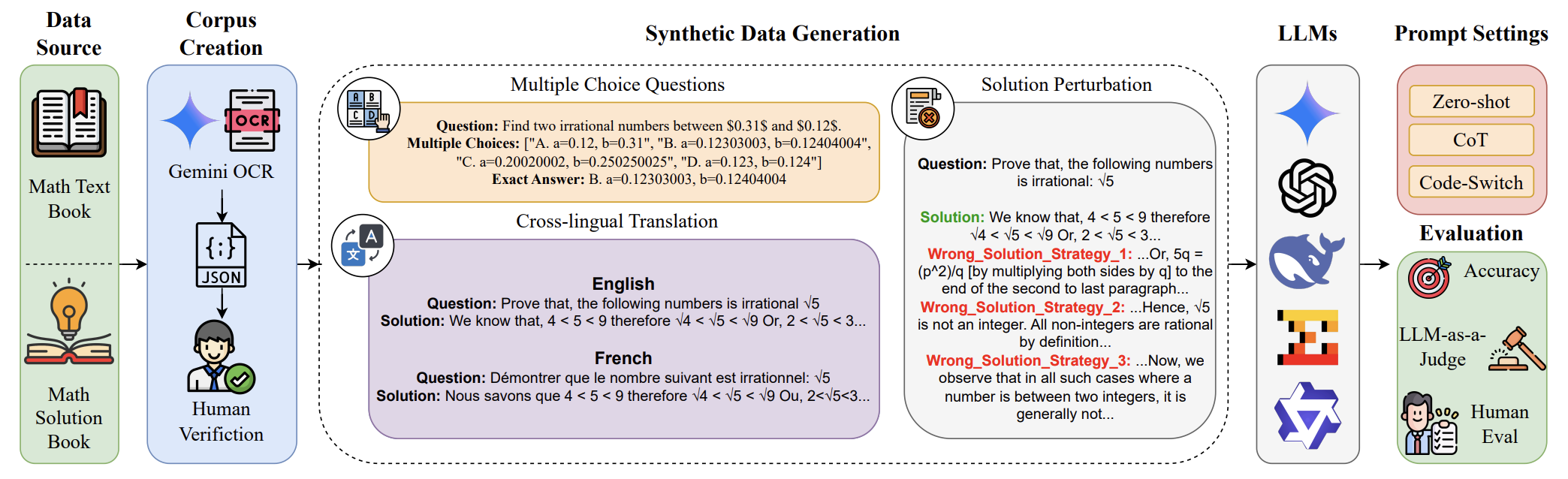
Overview of MATHMIST data creation and evaluation pipeline. (Left)
Data Sourcing and corpus creation uses Gemini OCR on textbooks,
stores data to JSONL, and applies human verification. (Center)
Synthetic data generation encompasses Multiple Choice Question
(MCQ) generation, Cross-Lingual Translation, and Solution
Perturbation. (Right) The evaluation process tests various LLMs
under different prompt settings.
ACL2025
Do Multi-Agents Solve Better Than Single? Evaluating Agentic Frameworks
for Diagram-Grounded Geometry Problem Solving and Reasoning
ARR October Cycle 2025 | Conference Paper
Diagram-grounded geometry problem solving is a critical benchmark for
multimodal large language models (MLLMs), yet the benefits of
multi-agent design over single-agent remain unclear. We systematically
compare single-agent and multi-agent pipelines on four visual math
benchmarks: Geometry3K, MathVerse, OlympiadBench, and We-Math. For
open-source models, multi-agent consistently improves performance. For
example, Qwen-2.5-VL (7B) gains +6.8 points and Qwen-2.5-VL (32B) gains
+3.3 on Geometry3K, and both Qwen-2.5-VL variants see further gains on
OlympiadBench and We-Math. In contrast, the closed-source
Gemini-2.0-Flash generally performs better in single-agent mode on
classic benchmarks, while multi-agent yields only modest improvements on
the newer We-Math dataset. These findings show that multi-agent
pipelines provide clear benefits for open-source models and can assist
strong proprietary systems on newer, less familiar benchmarks, but
agentic decomposition is not universally optimal. All code, data, and
reasoning files are available at
https://github.com/faiyazabdullah/Interpreter-Solver
@article{sobhani2025multi,
  title={Do Multi-Agents Solve Better Than Single? Evaluating Agentic Frameworks for Diagram-Grounded Geometry Problem Solving and Reasoning},
  author={Sobhani, Mahbub E and Sayeedi, Md Faiyaz Abdullah and Alam, Mohammad Nehad and Progga, Proma Hossain and Shatabda, Swakkhar},
  journal={arXiv preprint arXiv:2512.16698},
  year={2025}
}
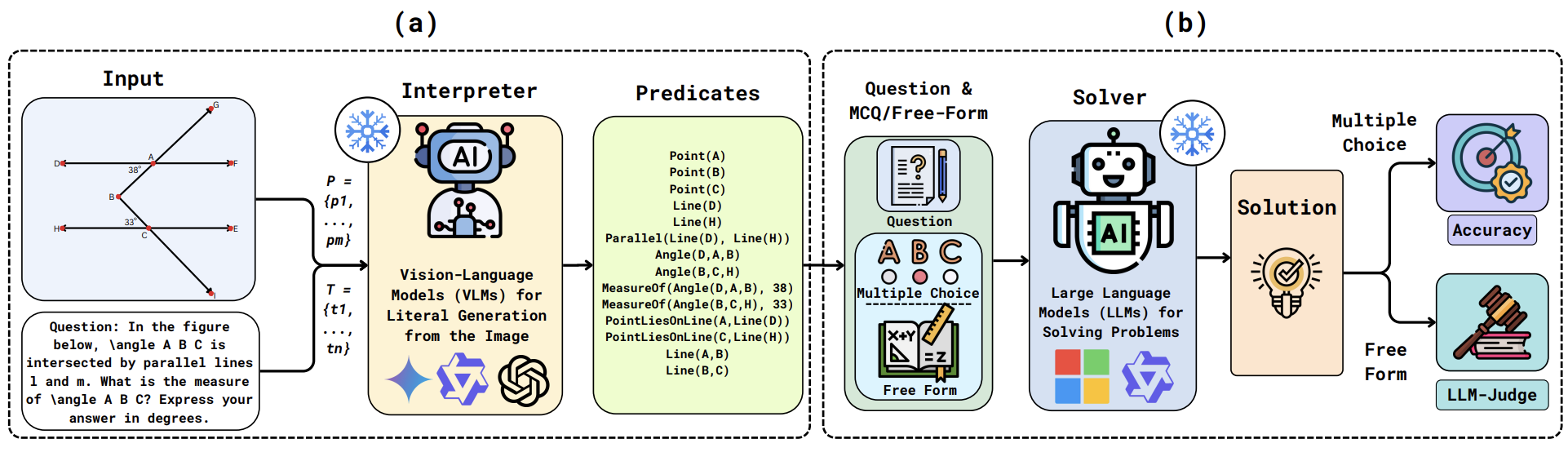
(a) An Interpreter Agent generates formal predicates from images
and questions using VLMs. (b) A Solver Agent then solves the
problem using these predicates as LLM input.
IJCNLP-AACL2025
CodeMist: A Transformer-Based Framework for Bangla Instruction-to-Code
Generation
Bangla Language Processing Workshop 2025 | Conference Paper
We propose CodeMist, a hybrid framework for Bangla-to-Python code
generation, focusing on enhancing code accuracy through a two-stage
pipeline of generation and debugging. In the development phase,
standalone models such as TigerLLM and StarCoder achieved low accuracies
of 27% and 24%, respectively, while advanced models like
Gemini-1.5-flash and Gemma reached 60% and 64%. Pairing Gemma with the
GPT-OSS debugger resulted in a substantial improvement to 99.75%,
emphasizing the importance of a dedicated debugging stage. In the test
phase on unseen data, GPT-OSS alone achieved 67%, which increased to 71%
with self-debugging. The highest performance of 84% was achieved by
combining Gemini-2.5-flash as the generator with GPT-OSS for debugging.
These results demonstrate that integrating a strong generative model
with an effective debugging component produces superior and robust code
generation outcomes, outperforming existing approaches such as TigerLLM.
The full implementation of the framework is publicly available at
https://github.com/ fahmid-juboraj/Code_generation.
@inproceedings{juboraj2025bracucl,
  title = "{BRACU}{\_}{CL} at {BLP}-2025 Task 2: {C}ode{M}ist: A Transformer-Based Framework for {B}angla Instruction-to-Code Generation",
  author = "Juboraj, Md. Fahmid-Ul-Alam  and Niloy, Soumik Deb  and E Sobhani, Mahbub  and Sadeque, Farig",
  editor = "Alam, Firoj  and Kar, Sudipta  andChowdhury, Shammur Absar  and Hassan, Naeemul  and Prince, Enamul Hoque  and Tasnim, Mohiuddin  and Rony, Md Rashad Al Hasan  and Rahman, Md Tahmid Rahman",
  booktitle = "Proceedings of the Second Workshop on Bangla Language Processing (BLP-2025)",
  month = dec,
  year = "2025",
  address = "Mumbai, India",
  publisher = "Association for Computational Linguistics",
  url = "https://aclanthology.org/2025.banglalp-1.67/",
  pages = "656--662",
  ISBN = "979-8-89176-314-2"
}
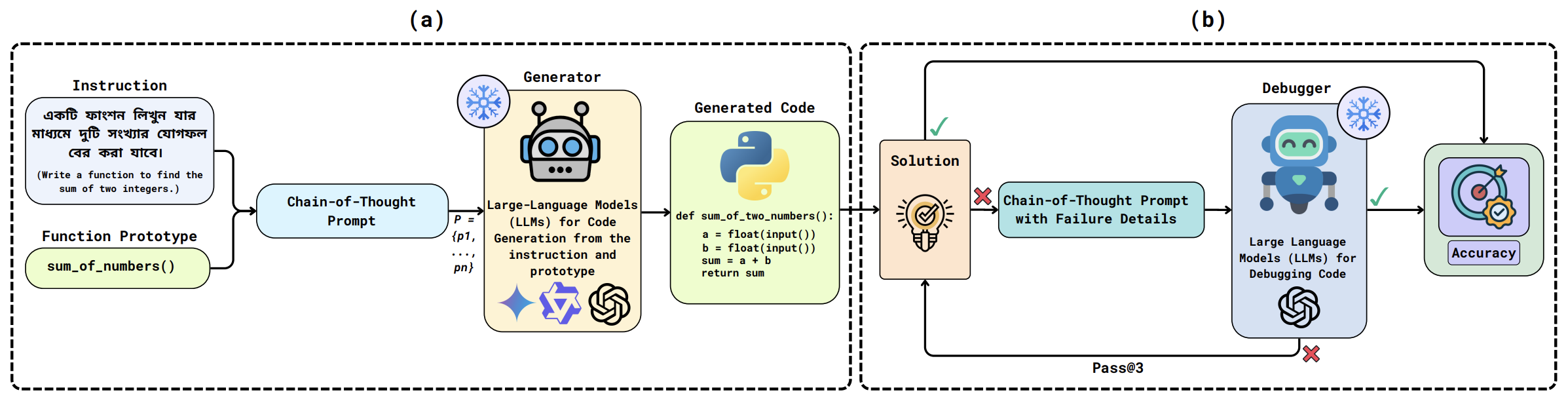
(a) A Chain-of-Thought prompt combines a natural-language
instruction in Bangla with a function prototype, which is provided
to the Generator to produce candidate implementations. (b) A
Debugger constructs a Chain-of-Thought prompt with failure
details, and debugging LLMs are engaged to iteratively repair and
re-evaluate the generated code, where (tick) denotes correct code
and (cross) denotes faulty code.
IEEE2024
An Enhanced Text Compression Approach Using Transformer-based Language
Models
2024 IEEE Region 10 Symposium | Conference Paper
Text compression shrinks textual data while keeping crucial information,
eradicating constraints on storage, bandwidth, and computational
efficacy. The integration of lossless compression techniques with
transformer-based text decompression has received negligible attention,
despite the increasing volume of English text data in communication. The
primary barrier in advancing text compression and restoration involves
optimizing transformer-based approaches with efficient preprocessing and
integrating lossless compression algorithms. We propose a
transformer-based method named RejuvenateFormer for text decompression,
addressing prior issues by harnessing a new preprocessing technique and
a lossless compression method. Our meticulous pre-processing technique
incorporating the Lempel-Ziv-Welch algorithm achieves compression ratios
of 12.57, 13.38, and 11.42 on the BookCorpus, EN-DE, and EN-FR corpora,
thus showing state-of-the-art compression ratios compared to other deep
learning and traditional approaches.
@inproceedings{rahman2024enhanced,
  title={An Enhanced Text Compression Approach Using Transformer-based Language Models},
  author={Rahman, Chowdhury Mofizur and Sobhani, Mahbub E and Rodela, Anika Tasnim and Shatabda, Swakkhar},
  booktitle={2024 IEEE Region 10 Symposium (TENSYMP)},
  pages={1--6},
  year={2024},
  organization={IEEE}
}
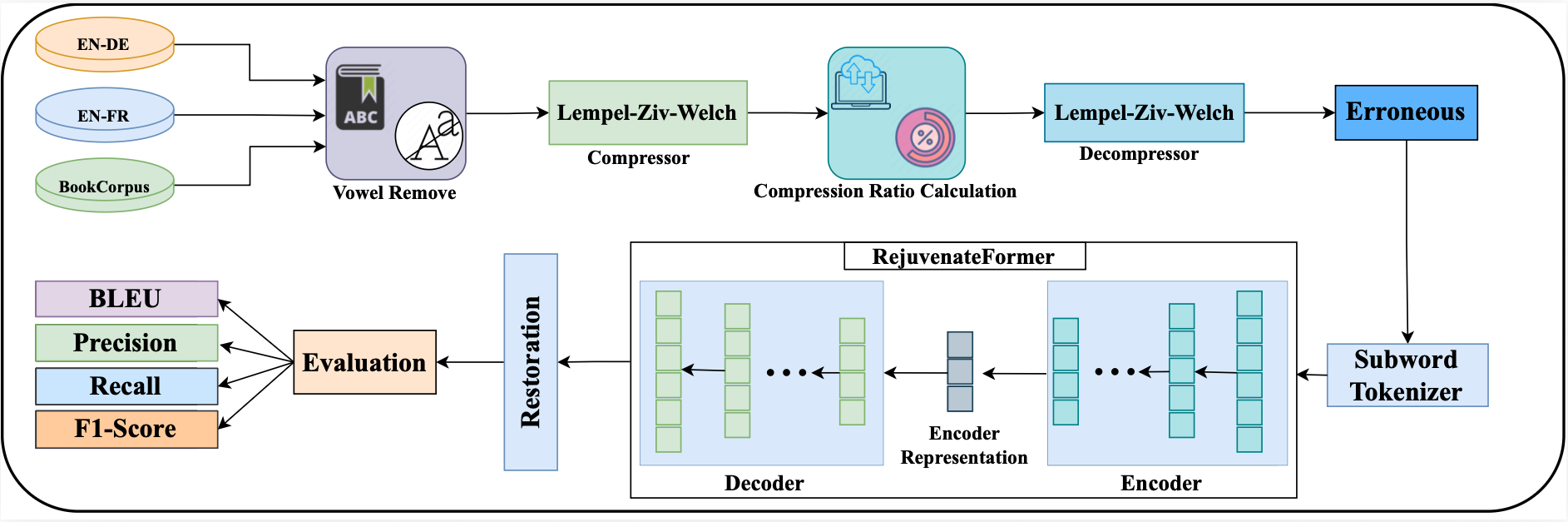
(Top) Each corpus undergoes vowel removal, and the compression
ratio is calculated using the compressed representation. The text
is then reverted to its earliest form without vowels. (Bottom)
After tokenization, the RejuvenateFormer is trained on each
corpus, to proficiently generate expected outcomes.
EMNLP2023
Advancing bangla punctuation restoration by a monolingual
transformer-based method and a large-scale corpus
Bangla Language Processing Workshop 2023 | Conference Paper
Punctuation restoration is the endeavor of reinstating and rectifying
missing or improper punctuation marks within a text, thereby eradicating
ambiguity in written discourse. The Bangla punctuation restoration task
has received little attention and exploration, despitethe rising
popularity of textual communication in the language. The primary
hindrances in the advancement of the task revolve aroundthe utilization
of transformer-based methods and an openly accessible extensive corpus,
challenges that we discovered remainedunresolved in earlier efforts. In
this study, we propose a baseline by introducing a mono-lingual
transformer-based method named Jatikarok, where the effectiveness of
transfer learning has been meticulously scrutinized, and a large-scale
corpus containing 1.48M source-target pairs to resolve the previous
issues. The Jatikarok attains accuracy rates of 95.2%, 85.13%, and
91.36% on the BanglaPRCorpus, Prothom-Alo Balanced, and BanglaOPUS
corpora, thereby establishing itself as the state-of-the-art method
through its superior performance compared to BanglaT5 and T5-Small.
Jatikarok and BanglaPRCorpus are publicly available at:
https://github.com/mehedihasanbijoy/Jatikarok-and-BanglaPRCorpus
@inproceedings{bijoy2023advancing,
  title={Advancing Bangla Punctuation Restoration by a Monolingual Transformer-Based Method and a Large-Scale Corpus},
  author={Bijoy, Mehedi Hasan and Faria, Mir Fatema Afroz and Sobhani, Mahbub E and Ferdoush, Tanzid and Shatabda, Swakkhar},
  booktitle={The First Workshop on Bangla Language Processing (BLP-2023)},
  pages={18},
  year={2023}
}
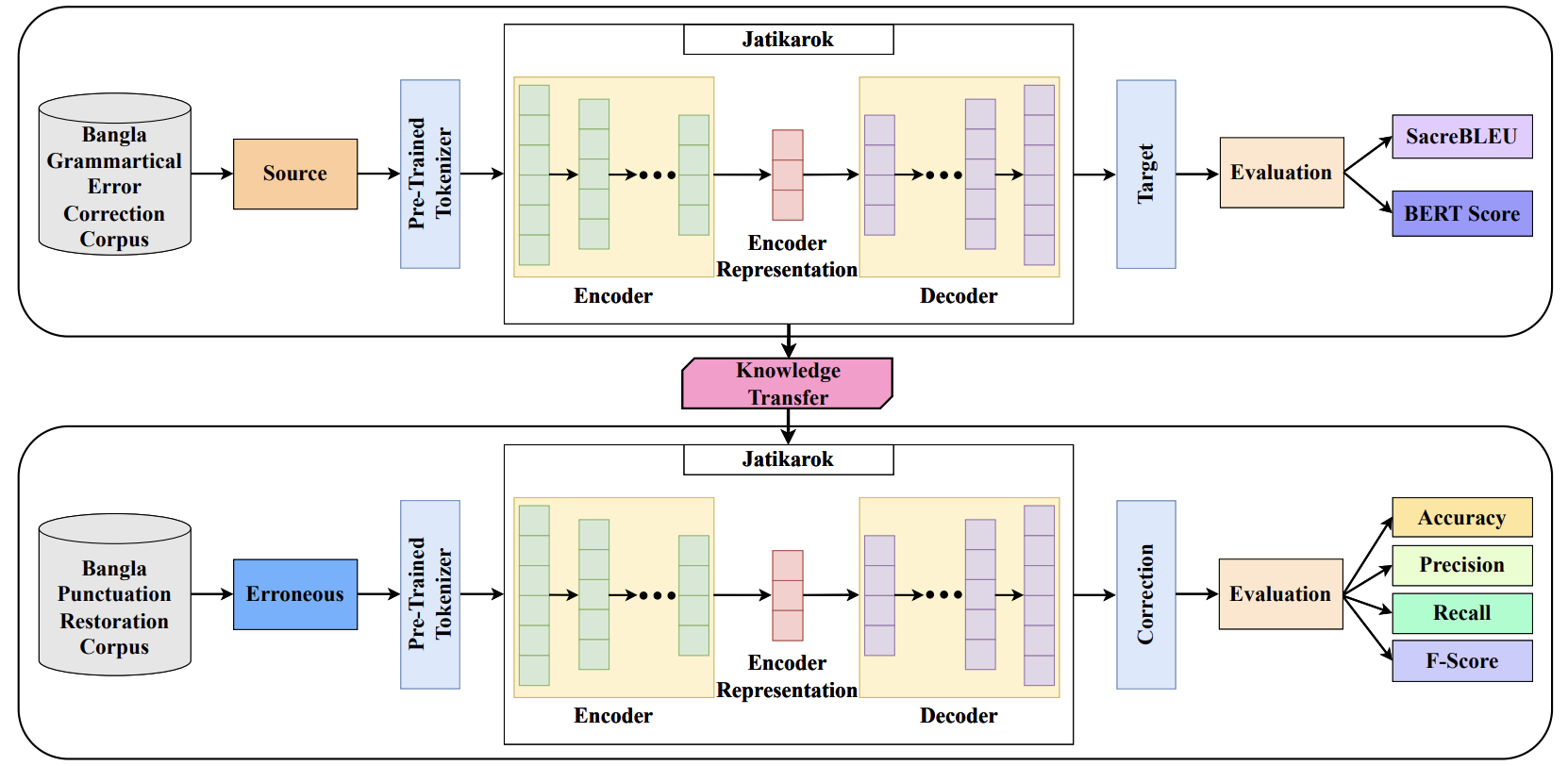
(Top) Jatikarok is initially trained on the Bangla Grammatical
Error Correction (BGEC) task. (Middle) The insights acquired
during the BGEC training are preserved for subsequent knowledge
transfer to the Bangla Punctuation Restoration (BPR) task.
(Bottom) Jatikarok is then fine-tuned on BPR corpora, leveraging
the knowledge gleaned from the BGEC task.
ACLUnder Review
BanglaVerse: A Benchmark Dataset for Visual Understanding of
Multilingual Vision-Language Models in Bangla with Cultural Awareness.
ARR October Cycle 2025 | Conference Paper | Under Review
Abstract
Research Methodology:
Demo Text
PLOS ONE2025
Adaptive TreeHive: Ensemble of trees for enhancing imbalanced intrusion
classification
Journal Article
Imbalanced intrusion classification is a complex and challenging task as
there are few number of instances/intrusions generally considered as
minority instances/intrusions in the imbalanced intrusion datasets. Data
sampling methods such as over-sampling and under-sampling methods are
commonly applied for dealing with imbalanced intrusion data. In
over-sampling, synthetic minority instances are generated e.g. SMOTE
(Synthetic Minority Over-sampling Technique) and on the contrary,
under-sampling methods remove the majority-class instances to create
balanced data e.g. random under-sampling. Both over-sampling and
under-sampling methods have the disadvantages as over-sampling technique
creates overfitting and under-sampling technique ignores a large portion
of the data. Ensemble learning in supervised machine learning is also a
common technique for handling imbalanced data. Random Forest and Bagging
techniques address the overfitting problem, and Boosting (AdaBoost)
gives more attention to the minority-class instances in its iterations.
In this paper, we have proposed a method for selecting the most
informative instances that represent the overall dataset. We have
applied both over-sampling and under-sampling techniques to balance the
data by employing the majority and minority informative instances. We
have used Random Forest, Bagging, and Boosting (AdaBoost) algorithms and
have compared their performances. We have used decision tree (C4.5) as
the base classifier of Random Forest and AdaBoost classifiers and naïve
Bayes classifier as the base classifier of the Bagging model. The
proposed method Adaptive TreeHive addresses both the issues of
imbalanced ratio and high dimensionality, resulting in reduced
computational power and execution time requirements. We have evaluated
the proposed Adaptive TreeHive method using five large-scale public
benchmark datasets. The experimental results, compared to data balancing
methods such as under-sampling and over-sampling, exhibit superior
performance of the Adaptive TreeHive with accuracy rates of 99.96%,
85.65%, 99.83%, 99.77%, and 95.54% on the NSL-KDD, UNSW-NB15,
CIC-IDS2017, CSE-CIC-IDS2018, and CICDDoS2019 datasets, respectively,
establishing the Adaptive TreeHive as a superior performer compared to
the traditional ensemble classifiers.
@article{sobhani2025adaptive,
  title={Adaptive TreeHive: Ensemble of trees for enhancing imbalanced intrusion classification},
  author={Sobhani, Mahbub E and Rodela, Anika Tasnim and Farid, Dewan Md},
  journal={PLoS One},
  volume={20},
  number={9},
  pages={e0331307},
  year={2025},
  publisher={Public Library of Science San Francisco, CA USA}
}
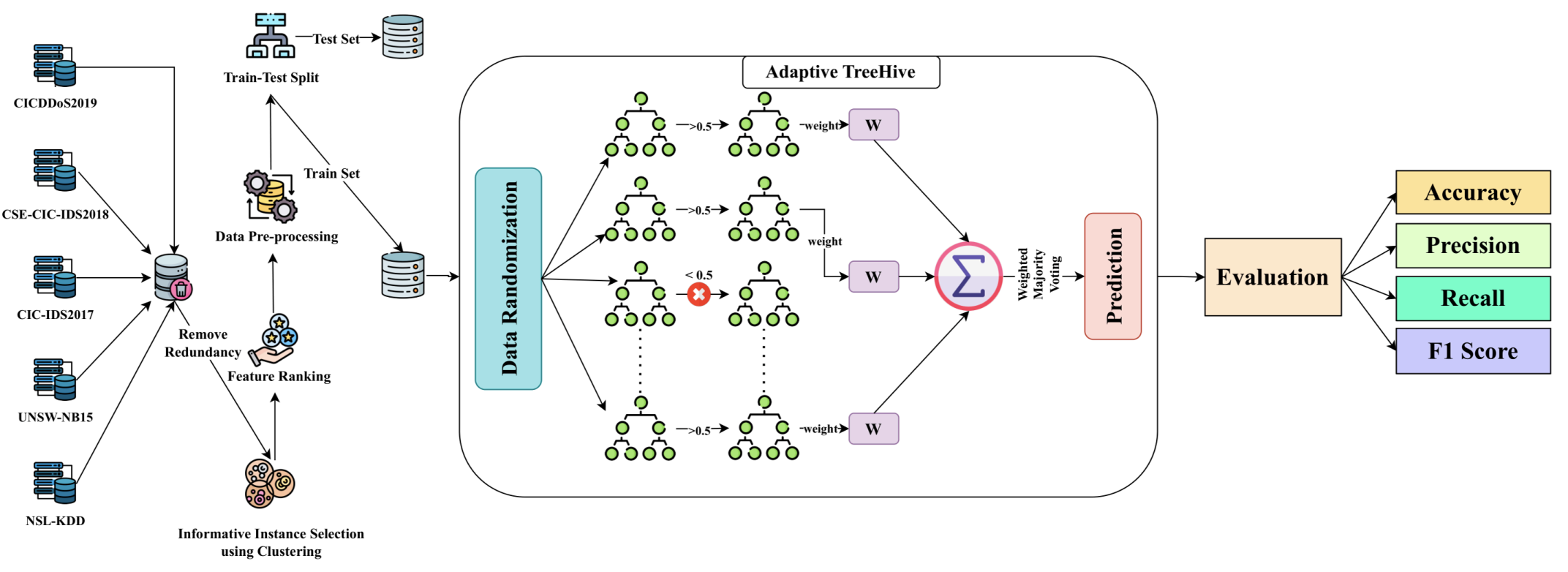
Adaptive TreeHive groups feature by gain ratio, build randomized
trees on each subset, and merge their outputs via weighted
majority voting. NSL-KDD, UNSW-NB15, CIC-IDS2017, CSE-CIC-IDS2018,
and CICDDoS2019 datasets are pre-processed, features ranked,
informative instances selected by clustering, redundancies
removed, and then split into training and testing sets. The chosen
trees (those exceeding a performance threshold) are trained on the
processed training set, assigned weights based on their error
rates, and their predictions are aggregated by weighted voting.
Performance is evaluated using accuracy, precision, recall, and
F1-score.
Crop Design2025
CropSynergy: Harnessing IoT Solutions for Smart and Efficient Crop
Management
Journal Article
Agriculture has been a cornerstone of human civilization and continues
evolving to meet the growing global population’s demands. In an era of
rapid technological advancement, the integration of smart agriculture,
also known as smart farming or precision farming, has become essential
for sustainable agricultural practices. This approach uses the Internet
of Things (IoT) and Artificial Intelligence (AI) to improve data
collection and analysis, facilitating real-time monitoring of crop
health, soil conditions, irrigation, and comprehensive farm management.
By incorporating IoT, farmers can make informed decisions, optimize
resource use, and improve crop yields. This study explores the scope of
integrating IoT into crop management to optimize traditional
crop-related issues and to improve the quality, production, and
marketing process. Our in-depth analysis illustrates the IoT
architecture, the IoT in smart farming, and how IoT sensors and devices
collect real-time data on soil moisture, temperature, humidity, and
other environmental factors, which are then processed using cloud
computing platforms and stored accordingly. After conducting an
exhaustive search with sorted keywords aligned with our research
interests, we have identified more than a thousand research articles. A
further filtering approach is applied based on inclusion and exclusion
criteria to select a significant number of well-suited articles, which
are thoroughly analyzed in the development of this systematic review
paper. The growing number of literature in this field has created a vast
area for exploration. In response, we have thoroughly studied all the
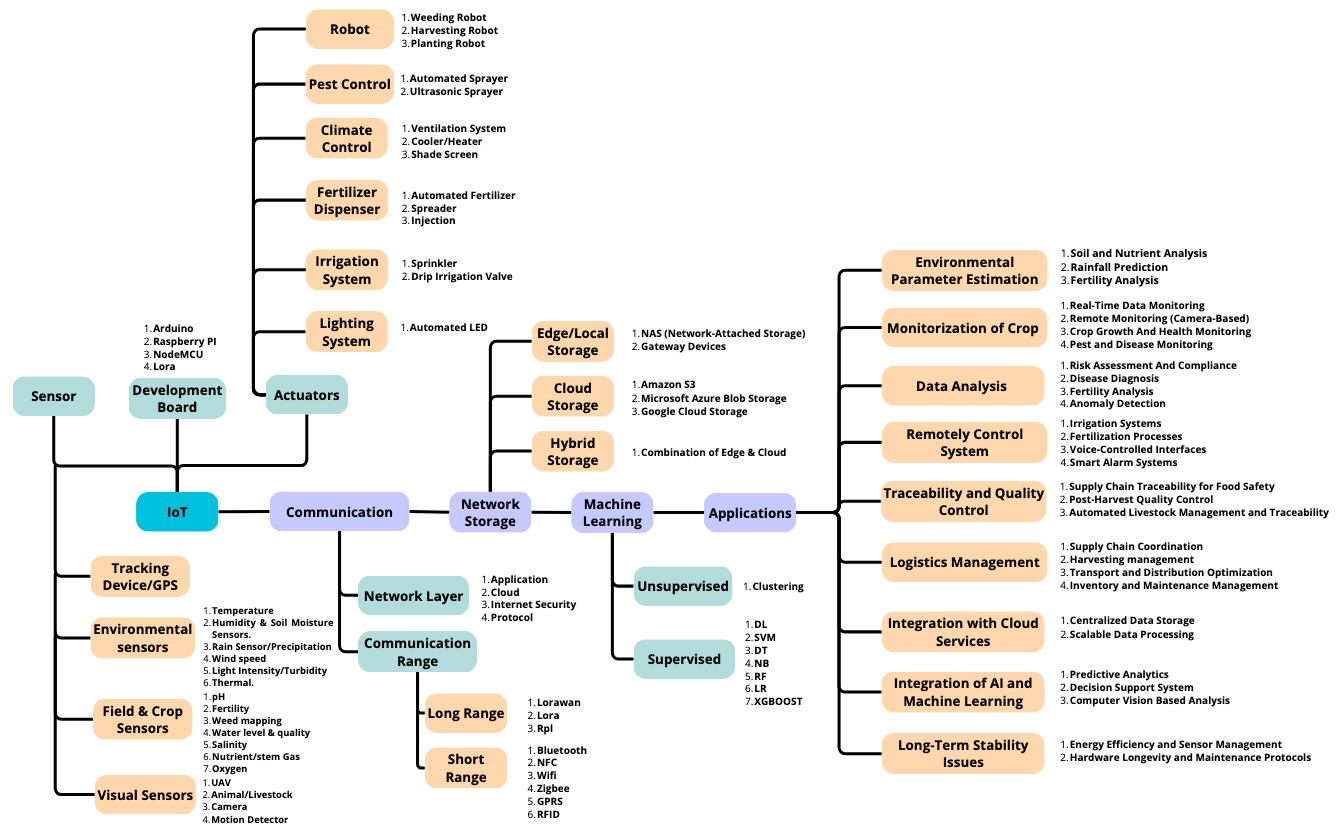
aspects of IoT and have proposed a novel taxonomy for IoT to
systematically classify and analyze key aspects like Sensors, Actuators,
Development Board, and Communication. We examine the application of IoT
in crop management, emphasizing its benefits, challenges, and future
potential. In addition, we analyze key IoT components, such as sensors,
data analytics, and decision-making tools, and explore their role in
enhancing agricultural sustainability, economic viability, and food
security. Finally, we concluded our study by addressing the challenges
and outlining future directions for further advancement.
@article{EYASIN2025100127,
  title = {CropSynergy: Harnessing IoT Solutions for Smart and Efficient Crop Management},
  journal = {Crop Design},
  pages = {100127},
  year = {2025},
  issn = {2772-8994},
  doi = {https://doi.org/10.1016/j.cropd.2025.100127},
  url = {https://www.sciencedirect.com/science/article/pii/S2772899425000333},
  author = {Md Sanzid Hossain Eyasin and Mahbub E. Sobhani and Shamima Nasrin and Abu Sadat {Al Rafi} and A.K.M. {Muzahidul Islam}}
}
TextEconomizer: Enhancing Lossy Text Compression with Denoising
Transformers and Entropy Coding
Journal Article | Under 1st Revision
Abstract here.
BibTeX here.
Paper information here.
Research Methodology:
Lossy compression framework preserving semantic meaning while
achieving high compression ratios using semantic similarity
metrics and context-aware pruning.
PLOS ONEUnder Review
BanglaHateCorpus: A large-scale Bangla benchmark for hate speech
classification and a transformer-based deep learning method.
Journal Article | Under Review
Abstract here.
BibTeX here.
Paper info here.
Research Methodology:
Large-scale corpus of 50,000+ annotated Bangla samples for hate
speech detection, validated through inter-annotator agreement
protocols achieving κ > 0.85.
International Journal of Network ManagementUnder Review
Data security and energy-efficiency in wireless body area networks: A
systematic review.
Journal Article | Under Review
Abstract here.
BibTeX here.
Paper info here.
Research Methodology:
Optimized WBAN architecture combining AES-128 encryption with
energy-efficient routing protocols, balancing security with power
constraints through adaptive techniques.